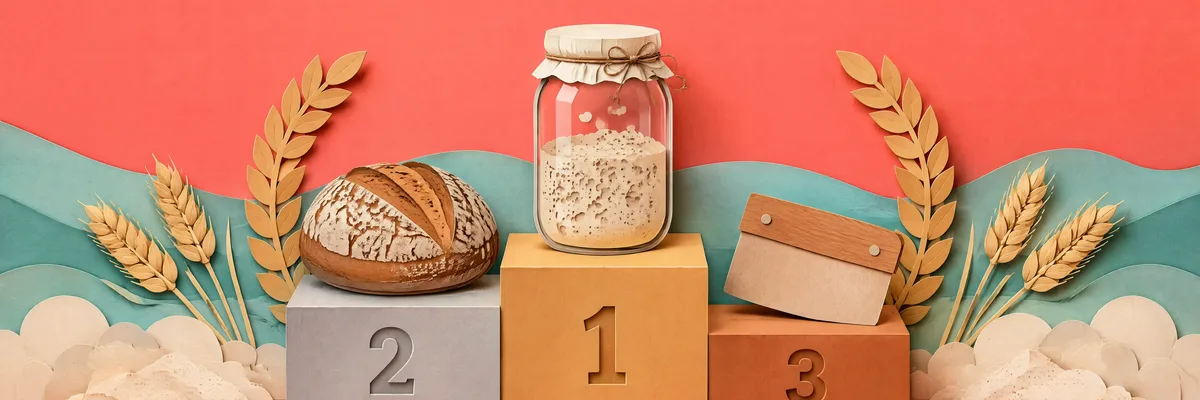
Top 10 Best sourdough starter kits for home bakers 2026
Starting a loaf from scratch means either coaxing wild yeast for two weeks or buying a culture that already works. Sourdough starter kits skip the guesswork: a proven strain plus the jar, scale, and instructions to bake a real crust by the weekend. This rating gathers options for home bakers who want dependable rise, not a science project taking over the counter.
The comparison looked at what matters at the kitchen table: whether the culture arrives dried or live, how fast it wakes up, and what lands in the box beyond the starter itself. Price, shipping reach, refill policy, and the clarity of the instructions all counted. Gluten-free options and heirloom strains with a traceable history earned extra weight, since not every baker wants the same tang or the same flour.
Positions here move on community votes, never on who paid. Read each card for the honest trade-offs: the pros, the cons, and the reviews left by people who actually fed the culture for a month. Weigh what a sourdough starter kit costs against what it delivers, then pick the one that fits your flour, your schedule, and your patience.
A modest set built around a wide mouth glass mason jar, a silicone spatula and a lid marked so the baker can note the last feeding. Nothing here tries to be clever: the jar is straight enough to scrape clean, the mouth takes a hand comfortably, and the whole thing goes in the dishwasher. Cultures for Health also lists a bundle version that adds a dehydrated San Francisco culture, which is worth checking before ordering, since the plain kit ships without any culture inside.
Good pick for someone who already keeps a starter in a random takeaway container and wants a proper home for it, or for a first attempt with flour and water. Bakers hoping for a full workshop will be disappointed: no banneton, no scale, no lame. The 24 ounce class jar also fills quickly if the household bakes two large loaves a week.
- Wide mouth jar, easy to scrape and clean
- Feeding reminder marking on the lid
- Dishwasher safe glass and silicone
- Costs less than most all in one kits
- Bundle option adds a dehydrated culture
- Culture not included in the plain kit
- No scale, basket or scoring tool
- Jar volume tight for frequent bakers
- Glass jar arrives at some risk of chips
Breadtopia designed this set around one idea: the baker should see what the starter is doing. The jar is custom made with straight walls and a lid that blocks dust yet still lets air move, so gas does not build up. A rubber o-ring slides around the glass to mark the level right after a feed, which turns guesswork about the peak into a simple visual check. A silicone spatula completes the set.
It suits methodical bakers who like measuring rise and keeping a feeding rhythm, and it makes a sensible gift for someone already curious about sourdough. Listings differ in what ships alongside the jar, so anyone counting on a culture should read the current description. Buyers who want baskets and a scale will need to shop for those separately.
- Straight walled jar, no dough trapped in curves
- O-ring marks the level after each feed
- Lid keeps dust out and lets air move
- Silicone spatula sized for the jar
- Backed by detailed Breadtopia guides
- Kit contents vary between listings
- No baskets, scale or scoring tools
- Priced above a plain mason jar setup
This is a working culture, not a packet of powder: it arrives alive and needs feeding the day it lands on the doorstep. Breadtopia grows it on organic, non GMO flour, so the first loaf can happen within a couple of days instead of the week or more a dehydrated culture usually asks for. The listing states plainly that the starter must be fed immediately, which is honest and worth taking seriously.
Sensible for a baker who wants dough in the oven this weekend and can be home to receive the parcel. Anyone travelling, or gifting to a person who may leave the box on a porch in July, should choose the dehydrated version instead. Once established, the culture behaves like any other and costs nothing to maintain beyond flour.
- Arrives active, ready to bake within days
- Grown on organic non GMO flour
- No long rehydration schedule to follow
- Clear feeding instructions in the box
- Must be fed the day it arrives
- Heat or shipping delays can weaken it
- Poor choice as a surprise gift
- No jar or tools included
A small cabinet that holds a starter jar at a chosen temperature anywhere from 41 to 122 degrees Fahrenheit, which is 5 to 50 Celsius. It both heats and cools, so the same box slows a starter in a hot August kitchen and keeps it lively in a draughty winter flat. Set it to a low temperature and the starter can go days between feeds; set it warm and it peaks on schedule, which makes timing a bake far less of a lottery.
The appeal is repeatability: same temperature, same rise, same flavour week after week. It is overkill for anyone baking once a month, and the base unit is sold without jars in most configurations, though a bundle with a starter jar exists. Counter space and a free socket are required, and the price sits in appliance territory rather than accessory territory.
- Heats and cools, 41 to 122 degrees Fahrenheit
- Stable temperature means predictable rise
- Low settings stretch time between feeds
- Compact footprint for a countertop
- Same unit useful for other ferments
- Costs far more than a jar kit
- Jars usually sold separately
- Takes up counter space and a socket
- Only fits small containers
Two 0.35 litre wide mouth Kilner jars, a stainless steel measuring lid, a plain stainless lid, a silicone spatula, two rubber bands, six labels and a step by step booklet. The measuring lid is the clever part: it portions flour and water for feeds without a separate scale, so the routine stays quick. Two jars mean one can hold the working starter while the other rests in the fridge as insurance. Walmart lists the set at around 33 dollars.
This suits a careful beginner who wants a tidy, labelled system and a printed guide rather than a phone full of screenshots. Volume bakers will find 0.35 litre jars small, since an active starter can double and climb the walls. No culture is included, so plan on either a packet or a homemade start from flour and water.
- Two jars, one working and one backup
- Measuring lid portions feeds without a scale
- Labels and rubber bands for tracking
- Printed step by step recipe booklet
- Classic Kilner glass, easy to replace
- Jars hold only 0.35 litre each
- No culture in the box
- Dearer than two plain mason jars
- Labels run out and need replacing
A gift boxed set around a 9 inch round rattan banneton, the size that suits a standard boule of roughly 750 grams of dough. The basket is woven from A grade rattan, comes with a cloth liner for softer crusts and finer flour handling, and is joined by scoring and scraping tools plus a printed guide. Everything is packed to be handed over as a present, which explains much of its popularity.
Best for a baker who has a starter going and now wants shape rather than a puddle of dough on a tray. The rattan spiral leaves the familiar rings on the crust and wicks moisture from the surface, which helps scoring. Rattan does need respect: brush it out, let it dry fully, never soak it. Anyone still without a live culture should buy a starter separately, since none is included.
- 9 inch rattan basket fits a standard boule
- Cloth liner included for smoother crusts
- Scoring and scraping tools in the box
- Gift ready packaging
- Printed beginner guide
- No starter culture supplied
- Rattan cannot be washed or soaked
- One size only, no oval option
- Liner needs frequent shaking out
Two baskets instead of one: a round banneton for boules and an oval for batards, both rattan, supplied with liners, a scoring lame and a dough scraper. Having both shapes matters more than it sounds, because an oval loaf fits a domestic oven and a bread tin far better than a wide round one. The rattan is untreated, so it dusts easily with rice flour and releases dough without fuss.
A reasonable choice for a household that bakes more than one loaf at a time or wants to alternate shapes. Blades on the lame are replaceable and should be handled with care in a kitchen with children. As with every basket set, no culture and no jar are part of the deal, and the baskets need thorough air drying between bakes or they will hold moisture and smell stale.
- Round and oval baskets in one purchase
- Liners included for both shapes
- Lame with replaceable blades
- Untreated rattan releases dough cleanly
- Oval shape suits ordinary home ovens
- No jar or culture included
- Baskets must never be soaked
- Blades need careful storage
- Bulky to keep in a small kitchen
Goldie is a warming base with a glass dome that holds a starter jar in a narrow comfortable band, roughly 75 to 82 degrees Fahrenheit, the range where most cultures ferment briskly without turning sour and sluggish. A light on the base shows when it is warming, power draw is tiny, and the dome doubles as a cover so the jar is not sitting under a tea towel on a windowsill. The design is deliberately quiet: no fan, no display, no menu of settings.
Worth the money for anyone whose kitchen sits below 68 degrees for half the year, since a cold starter is the most common reason bread refuses to rise. It only warms, so a hot summer flat gains nothing from it. Jar options vary between configurations, and the base needs a free socket on the worktop.
- Holds the starter around 75 to 82 Fahrenheit
- Very low power draw
- Glass dome protects and covers the jar
- Indicator light shows warming status
- Silent, nothing to program
- Warms only, cannot cool a hot kitchen
- Expensive next to a plain jar kit
- Jar included depends on configuration
- Occupies a socket and worktop space
A dehydrated culture sold as a San Francisco heirloom lineage, shipped as dried flakes with a short instruction sheet. Dried starters travel well and keep for a long time in a cupboard, which is their main advantage over live cultures: nothing spoils if the parcel sits an extra day. Reactivation takes a few days of feeding, and the seller is known for replying to questions when the process stalls, which matters more than any claim on the label.
A calm option for a first attempt, a spare in the pantry, or a gift that can wait. The romance of a century old lineage should be taken lightly, since a culture adapts to local flour and water within weeks and tastes accordingly. Nothing else is included, so a jar, a scale and a basket have to come from elsewhere.
- Dried flakes keep for months unopened
- Survives shipping delays and heat
- Simple printed reactivation instructions
- Responsive support from a small seller
- Cheap way to test sourdough baking
- Needs several days before first bake
- Lineage claims cannot be verified
- No jar or tools included
- Results depend on local flour and water
A dehydrated heirloom culture grown on whole wheat and made with non GMO ingredients, supplied as a single packet with activation instructions. Whole wheat starters tend to wake up quickly and smell nuttier than white flour cultures, and this one is marketed for more than bread: pancakes, muffins, waffles and whole wheat pasta all work from the same jar of discard.
A practical starting point for households that already keep whole wheat flour and prefer not to buy white flour just to feed a jar. Expect several days of feeding before the first loaf, and expect a fast, hungry culture once it wakes, since whole grain flour ferments briskly and needs feeding on schedule in a warm kitchen. Equipment is not part of the packet.
- Dehydrated packet stores well in a cupboard
- Whole wheat culture wakes up quickly
- Non GMO ingredients
- Discard works for pancakes and pasta
- Instructions printed on the packaging
- Several days of feeding before baking
- Needs whole wheat flour to activate
- Ferments fast and demands regular feeds
- No jar, spatula or basket included